What is your role at the museum: I am the tourism and social media coordinator. I am a ‘Jack of All Trades’ at the Museum. Essentially, I run social media, develop new programming opportunities, and design exhibits. I also answer the phones if you ever decide to call in!
What inspired me to work in the museum field: I was originally a radio broadcaster – museums weren’t on my horizon. Early on in my career, it was apparent that I was heavily invested in telling the history of Canada. I used my time within the broadcast booth to create stories involving the history of our country. I delved into story after story, which helped me realize how much I wanted to share these historical stories with the wider public. I went on to get my undergrad in history and a masters in museum studies. With all my experiences, I hope to share my love of history with Lac La Biche County.
What is your favourite part of working at the museum: I’m very new to this museum! Currently, I interact with visitors coming through, creating social media posts through the website and various social medias that the museum uses. Speaking and interacting with the public truly brings home the museum experience for me. Previously, I’ve worked as an interpretive planner and visitor researcher in museums. What that essentially means is that I designed exhibits and galleries largely through the input of what the public wanted! What I truly liked was developing and creating multi-media exhibits that told stories, sometimes educational and all the time entertaining. That’s something I hope to bring to this museum in the years to come!
What is one exhibit that holds a special significance to you and why: I’ve yet had the opportunity to create exhibits at this museum. However, you can see the passion that the current, and previous, staff have put into creating the exhibits here. My personal favourite is the exhibit focused on the Boreal Biome you see as soon as you walk in. The exhibit is truly amazing, the auditory and spatial design of the exhibit is truly a sight to see. In the past, I have designed and researched gallery spaces at the Royal Ontario Museum, and the upcoming Greek Canadian Heritage Museum in Toronto, Ontario. Creating discovery based exhibits, where the public can interact with the exhibit and learn as they go, is something I find particularly rewarding as an exhibit designer.
How do promote the museum’s exhibits and programs to attract visitors: Attracting visitors to the museum’s exhibits is all about creating an amazing promotion campaign! Get to know your audience inside and out – what they love, what sparks their curiosity – and create engaging content that speaks to them. I don’t limit myself to one channel; Lac La Biche Museum has a wide selection of social medias! I also use email, website updates and collaboration to get my message across to Lac La Biche and the county. By understanding the museum’s audience and spreading the exciting ongoings at the Lac La Biche museum, I can draw in visitors and provide them an unforgettable experience!
In the next few days, we have an exciting new exhibit and contest popping up in the museum. Exploring the Backroads of Northeastern Alberta will showcase the local talent of photographers in the county. With a heavy emphasis on talent, the pictures that have been submitted are exceptional – every single one of them.
The exhibit is taking over the genealogy resources we have on the north wall by the front doors. I’ll be sad to see it go but continuous change keeps the museum fresh and exciting. Which is something that we strive for here, continuous change, continuous improvement and a better museum. I digress.
One of the more exciting aspects of the exhibit is that it opens it to you – the visitor! Throughout the month, up till September, the public gets to vote on which one they think stands out amongst the rest. The votes will be tallied up at the end and a winner will be announced on our social media! They also get a prize at the end to boot.
If you have a moment between July 24th and September 28th, step on by and vote!
We are thrilled to announce the unveiling of our new exhibit! Starting July 30th, prepare to be immersed in the captivating worlds of the History of Camping, taking center stage at the Lac La Biche Museum. When we say centre stage, we mean that quite literally. The exhibit will be taking over the entirety of our stage!
This exhibit will transport you through time, showcasing the evolution of camping from its early beginnings to the present day. Explore a collection of vintage tents, discover an array of fascinating camping artifacts, and journey through captivating photographs that will capture the essence of summers past.
Mark your calendars, as this exhibit will be open until September 29th, giving you ample time to visit and experience the nostalgia and wonder of the History of Camping. Don’t miss out on this unique opportunity to delve into the rich outdoor heritage of our region.
Speaking of new content, if you haven’t already, make sure to check out our social media platforms! We regularly share unique insights into our exhibits, exciting promotions, and even offer chances to win prizes. And that’s not all – keep an eye on our Youtube channel for upcoming captivating content, designed to bring the museum experience right to your mobile screen. Stay connected and be part of our vibrant community!
Every Friday, we’ll be writing new and interesting blog posts! From museum theory, behind the scenes exclusive access to upcoming content, to posts from staff, and everything in between. Stay tuned for exciting content as we roll out an updated website!
To start us off, let’s look at museum theory. There are many concepts that guide museum theory, not just at Lac La Biche, but museums all across Canada. One of which is accessibility, one of the guiding core principles here at the Lac La Biche Museum. Let’s first delve into a bit of a history lesson.
In the past, museums faced numerous challenges when it came to providing access and inclusion for individuals with disabilities. Physical barriers, limited resources and a lack of general awareness hindered the ability of everyone to fully enjoy the museum experience. This all began to change by the second half of the 20th century as society started to recognize the importance of accessibility. During the 1960s, the disability rights movement that sprang up within North American began to emerge as a powerful force on the political stage. Their rallying cry, “one is not born disabled; one is made disabled by society”, boldly underscored the societal barriers and negative attitudes that perpetuated accessibility issues. This movement resonated deeply among legislators across Canada, at both a federal and provincial level. As a result of these protests and growing awareness, legislation was enacted and amendments made to the Canadian Human Rights Act, which made explicit mention of prohibiting discrimination based on disability. These legislations did not go unnoticed by museums across Canada and began to fundamentally shape guiding core principles and theories.
By the mid 1980s, the concept of visitor centered museums began to gain traction. What that means, is that museums started to recognize the importance of creating experiences that caters to a diverse interest, backgrounds and abilities of the visitor. Physical accessibility improvements, such as ramps, elevators, accessible washrooms and designated parking lots became common features in many museums. As the years turned and technology continued to advance, museums enthusiastically embraced innovative approaches to enhance accessibility. Museums began developing audio tours, multi-sensory exhibits, and immersive virtual reality experiences to engage visitors on multiple levels. More tactile elements began to be in incorporated into museum design, allowing for interactive and hand on exploration. This growing prevalence of digital accessibility empowered museums to create inclusive online programming, just like the website you’re currently exploring! Museums, like Lac La Biche, are committed to continuously improving accessibility and fostering a more inclusive environment. This means that museums are looking past physical accessibility alone. Museums are striving to address sensory, cognitive, social and emotional needs, which ensures that all visitors can fully participate and enjoy the exhibits and programs offered. Through these ongoing efforts, museums are transforming into vibrant and welcoming spaces that celebrate diversity and provide a welcoming experience for everyone.
ICOM (International Council of Museums) defines accessibility as: “the removal of barriers and the provision of inclusive opportunities, ensuring that all individuals, regardless of their background, abilities, or disabilities, can access, engage with, and benefit from museum experiences”. This definition impacts every level of museum work. From interpretive planning, visitor research, curation, design and construction. What does this all mean? Let’s break it down by the 6 ways in which accessibility can be measured in museums: physical, sensory, digital, interpretive, programmatic and attitudinal accessibility. This all starts with creating physical accessibility. Museums and its facilities are designed and equipped to accommodate visitors with mobility needs. Whether this is through wide hallways, elevators, ramps, rest areas and accessible parking. Exhibits are also opened to sensory accessibility. What this means is that the museum provides braille labelling for artifacts, audio guides, tactile elements as well as visual aids within the exhibit spaces. Museums have also embraced the digital age! Most museums have a website that details their exhibits, programming, promotions, and offers alternative text for images, captioned videos and utilizes accessible website design practices. This is what we call digital accessibility. Museums have also taken a more interpretive approach to accessibility design. Within the exhibits, you’ll commonly find materials that are easily read and understood. Text is generally minimal, or short, and is often in two or more languages. Utilizing a more universal design practice within the exhibits, opens the interpretive materials to a wider audience. Designing tours and programming that are sensory friendly, utilizing sign language, when possible, are all aspects of great programmatic accessibility. Lastly, a guiding principle of creating a more inclusive museum is attitudinal accessibility. This means exactly how it sounds. Museums have made a push to promote a more welcoming and inclusive environment by training staff to be respectful and knowledgeable of visitors from a diverse background and abilities.
Lac La Biche Museum is continuously exploring ways in which we can better address systemic accessibility issues and is continuously improving. With your continued support, Lac La Biche Museum will continue to create content, exhibits and materials to better serve and engage our diverse community. We are committed to improving accessibility in all its forms. Your support enables us to design inclusive spaces, provide multi-sensory experiences, enhance our digital presence and develop programs that cater to the unique needs of our visitors. Together we can break down barriers and ensure that everyone, regardless of background can fully enjoy and benefit from the rich cultural and historical resources at Lac La Biche Museum.
Herb Erickson was the Lakeland Archers’ oldest living archer. Born to a family living in a homestead on Pinehurst Lake, he was the seventh child of ten. In his childhood he was immersed in the wilderness and gained a great appreciation for the outdoors. He grew up surrounded by Indigenous boys from the Beaver Lake Cree Nation, who were exceptional archers. After repeated requests, one of his companions finally made a bow for him out of willow. He shot his first arrow between the ages of eight and nine. Thus began his passion for archery.
By eighteen years old, Herb was frequently practicing his shooting. He competed at his first provincial archery tournament in 1949. He only had a simple wooden bow, missing many elements that most of his competitors’ bows had. Even so, he astounded his competition with his incredible skill. His shooting method was not the typical aim and release method, but instead he shot by instinct. He fired very quickly, releasing an arrow seconds after the previous one was planted in the target. That 1949 tournament began a provincial winning streak lasting until 1957. That year, he began competing at the national level, and became the archery champion of Canada.
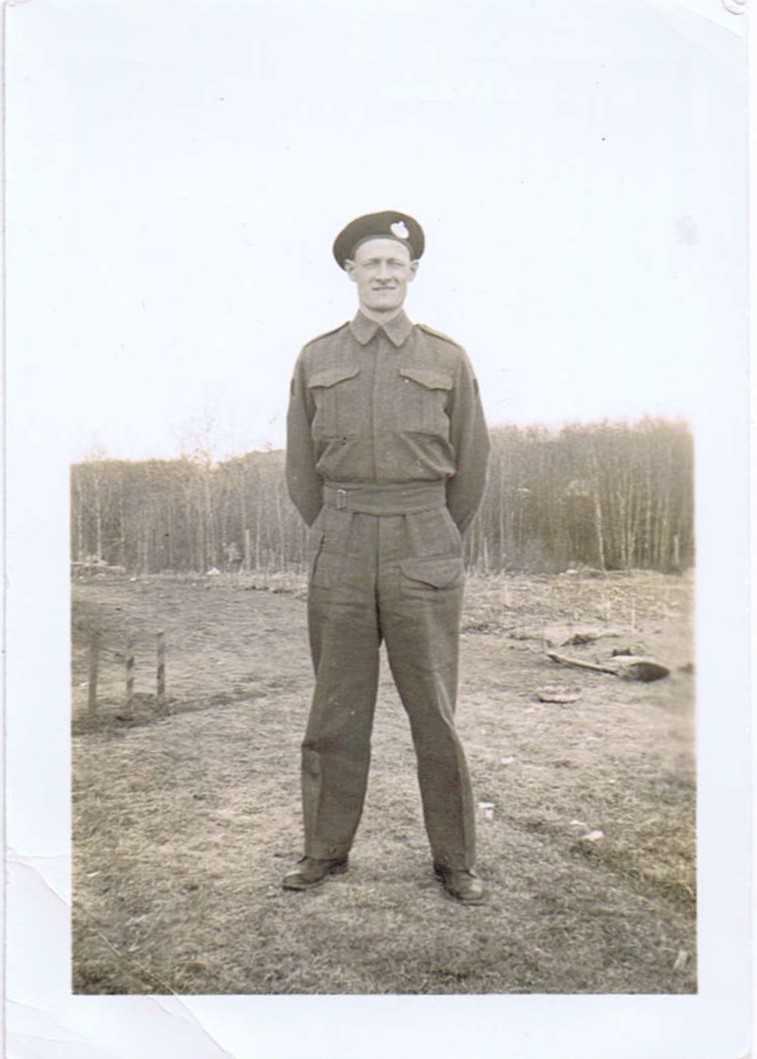
Not only was Herb Erickson known as an archer, but he was also an army veteran, trapper, and poet. In World War II, Herb enlisted in the army and was sent overseas to England. He was injured in the 1944 Battle of Dunkirk . A gunshot to his lower back left him vulnerable, and he was captured by German soldiers. They questioned him, but he refused to give up important information. Three days later, he was rescued by the Allied Forces.
Herb Erickson in uniform
After he was discharged from his duties in the war, the Canadian Army suggested that he join the travelling circus. However, Herb wanted to go home. He returned to the homestead that his parents had built and his life as a trapper. He had begun trapping at the age of sixteen; he was a trapper for 44 years and relied almost entirely on trapping for his income. During the Great Depression, Herb was able to trap squirrels and sell them for 9 cents per squirrel, a significant amount of money for the time. His peaceful, healthy lifestyle gave him time to write poetry about things that were important to him.
Herb Erickson was known as a gentle and fun person. He would commonly jump a lasso while spinning it and simultaneously playing the harmonica. With a quick hand, he did magic tricks that astounded those who watched. He used these tricks to amuse children at archery competitions. He was also a fantastic storyteller who could captivate an audience with tales of his trapping trade and the adventures he had experienced. Most importantly, he would help teach young archers and give them assistance if they needed it. His kindness, skill, and lifelong dedication to his craft has left him a hero in the archery world.
Further Reading:
Finlayson, D. (1999, October 14). An Almost Perfect Life. Edmonton Journal, pp. G1, G2.
Weber, M. (2000, April 24). The interesting life of Herbert Erickson. town and country, p. 5B.
Paul, D. (2003, June 9). The straight and arrow: Lakeland County resident still on target at 87. town and country, p. 14.
Johnson, G. A. (1999). Lac La Biche Chronicles (p. 296). Lac La Biche, Canada: Lakeland Interpretive Society.
Lakeland Archers. (n.d.). Profile of Herb Erickson. In https://www.lakelandarchers.ca/news-and-events/herb-erickson-profile. Retrieved from https://www.lakelandarchers.ca/news-and-events/herb-erickson-profile
Due to our expected move, all research requests will be suspended as of August 1, 2018, for an undetermined length of time as our archives will be unavailable. During this time, we will be preparing our archives for transportation and, if we proceed as expected, setting up our archives in a new facility. Please note that we will still accept research requests, but will likely be unable to fulfill them during this time.
Additionally, we will continue to accept donations for our archives throughout this process. Please make arrangements with our staff as we may be unexpectedly unavailable for drop-in donations after the summer.
If you have an urgent request that is time sensitive, please contact us here and note your request’s urgency. We apologize for any inconvenience.
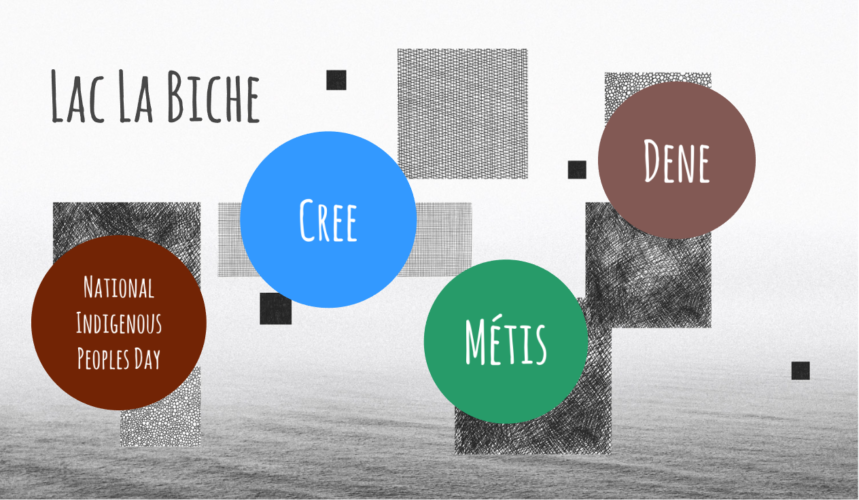
To celebrate National Indigenous Peoples Day (June 21), our talented staff has put together this Prezi on some of the major Indigenous groups living in our region. The diversity and cultural uniqueness of these many groups is what makes Canada such an amazing country to live in!
To view our Prezi, click on the image below!
National Indigenous Peoples Day 2018 Prezi (Click the image to view the Prezi! Note: It will take you to a new site.)
The Lakeland Interpretive Society is making an open call for bids regarding the design and construction of a Visitor Information Kiosk to be located in Plamondon.
The kiosk will need to have panels providing information about the area, as well as space for brochures to be displayed.
Bids should include:
design
details regarding hardware and hours of work required
timeline for completion of the project
broken down budget and total cost
Please email bids to director@laclabichemuseum.com by May 24th at 4pm.
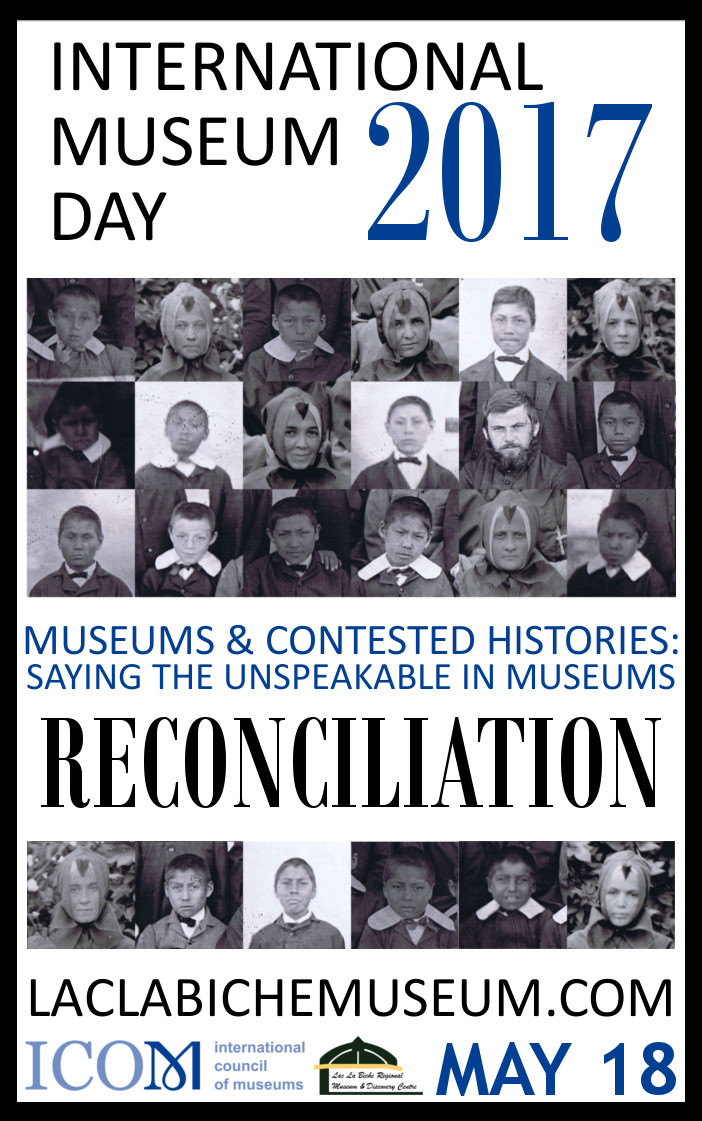
The theme of International Museum Day varies every year; this year, the theme is Museums and Contested Histories: Saying the Unspeakable in Museums. The purpose of this theme is to “highlight how the acceptance of a contested history is the first step in envisioning a shared future under the banner of reconciliation.”
Reconciliation is at the forefront of many minds, especially with this year marking the 150th anniversary of Canada’s confederation. The residential school system has officially been termed a cultural genocide by the Truth and Reconciliation Commission. The Truth and Reconciliation Commission of Canada was formed on June 2, 2008, with the mission of uncovering evidence on Canada’s Indian Residential School system (IRS) and fostering healing. Although the main task of the Truth and Reconciliation Commission was completed in December 2015, it falls to the rest of Canada to respond to the calls to action outlined by the TRC, including sustained public education and dialogue.
A residential school is defined as a boarding school for “Indian” students that was in part financed by the federal government of Canada. Under this definition, according to the Truth and Reconciliation Commission, the residential school at Lac La Biche, Notre Dame des Victoires, was in operation from 1893-1898. We know the site under many names: Notre Dame des Victoires, Hospice St. Joseph, and the Lac La Biche Mission.
From 1862 until the establishment of the industrial school, the boarding school run at Notre Dame des Victoires was not an official residential school as it predates the official system and did not receive federal funding before then. The boarding school established in 1905 was not a residential school either as it did not receive federal funding and First Nations students were to be sent to residential schools around the province. While Métis students were placed in residential schools at times, federal funding was not provided for them. It is important to note that the current owners of the mission site, the Lac La Biche Mission Historical Society, are not affiliated with the school or religious organizations that ran it.
This entry is meant to give a brief summary of the history of Notre Dame des Victories and is not intended to be an ultimate guide to the site’s history or residential schools. This is a short glimpse that will hopefully serve as a good introduction as we move towards reconciliation.
“And further, Her Majesty agrees to maintain schools for instruction in such reserves hereby made as to Her Government of the Dominion of Canada may seem advisable, whenever the Indians of the reserve shall deserve it.”
—Excerpt from Treaty 6, signed 1876
“When the school is on the reserve, the child lives with its parents, who are savages, and though he may learn to read and write, his habits and training mode of thought are Indian. He is simply a savage who can read and write. It has been strongly impressed upon myself, as head of the Department, that Indian children should be withdrawn as much as possible from the parental influence, and the only way to do that would be to put them in central training industrial schools where they will acquire the habits and modes of thought of white men.”
—John A. Macdonald to the House of Commons, May 9, 1883
The Indian Residential School System
The era of residential schools may be over, but the effects are certainly still felt. Roughly 150,000 Indigenous children (30% of Indigenous children) were placed in residential schools, the last of which closed in 1996. The purpose of residential schools was to assimilate Indigenous children into the mainstream Eurocentric society. This was to be done by completely preventing children from learning and participating in their own culture and forcing Eurocentric education upon them. The plan was to target children because they would not have been exposed to their own culture for very long, a “blank slate” that could be formed as the government wished.
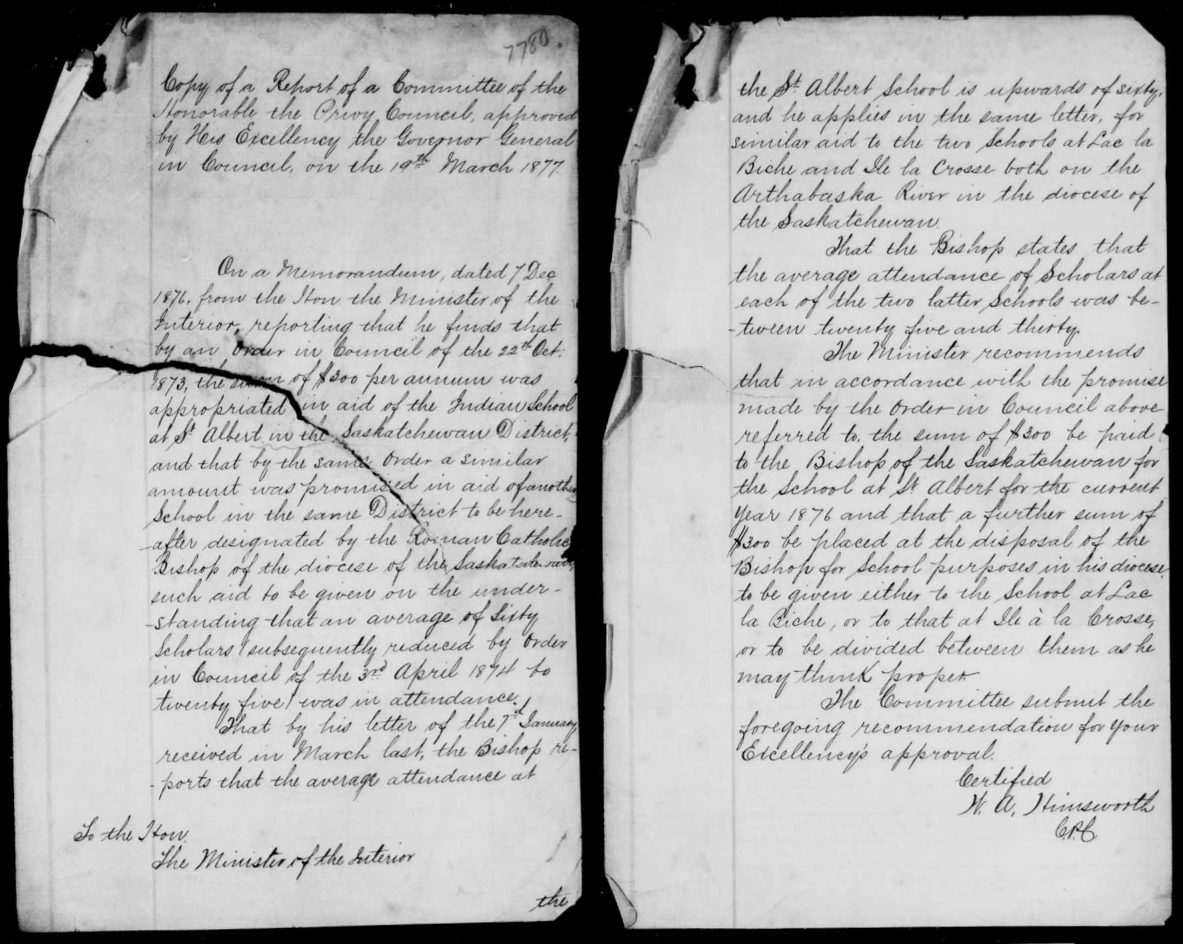
Copy of 1877 grant to schools. RG 10 Vol. 3643 File 7780 Pt. 1, Library & Archives Canada
To do this, the Canadian government partnered with religious organizations that had previous experience with schooling, namely the Roman Catholics, Anglicans, Protestants, and Presbyterians. These religious groups often had mission schools already established and were the only organizations providing schooling in the north. Bishop Vital-Justin Grandin in particular frequently asked the federal government to help existing schools continue educating Indigenous children by increasing grants. Bishop Grandin continued to channel his efforts to promote industrial and residential schools throughout the rest of his life.
“The fact is, that if you wish to educate those children you must separate them from their parents during the time they are being educated. If you leave them in the family they may know how to read and write, but they still remain savages, whereas by separating them in the way proposed, they acquire the habits and tastes — it is to be hoped only the good tastes — of civilized people.”
—Public Works Minister Sir Hector Langevin, 1883
Initially, attendance at the residential schools was not mandatory. Many children were in the school for a few years before being pulled out by parents to help the family. Other students were pulled out due to unaddressed complaints with the schools. The full version of the IRS system was not officially in place until the 1884 Amendment to the Indian Act of 1876. This amendment stated that First Nations children were to have mandatory education in order to read and write in English.
In 1873, a federal subsidy for schooling was announced by the Canadian government for an Oblate school in St. Albert for $300 per year. Payments were later authorized for other schools under the condition that they had at least twenty-five students. By 1876, three schools—St. Albert, Lac La Biche, and Île-à-la-Crosse—were announced to be eligible to receive federal support from the Ministry of the Interior, with $300 to be split between Lac La Biche and Île-à-la-Crosse, not awarded to each school.
Lac La Biche Boarding School 1862-1893
The Lac La Biche Mission, Notre Dame des Victoires, was a Roman Catholic mission established by the missionary order of the Oblates of Mary Immaculate. It was established in 1853 by Father Rene Remas and moved to its current site in 1885 by Father Augustin Maisonneuve and Father Jean Tissot. A school was established in 1862 with the arrival of the Sisters of Charity, also known as the Grey Nuns. The Grey Nuns were particularly involved in hospitals, orphanages, and schools.
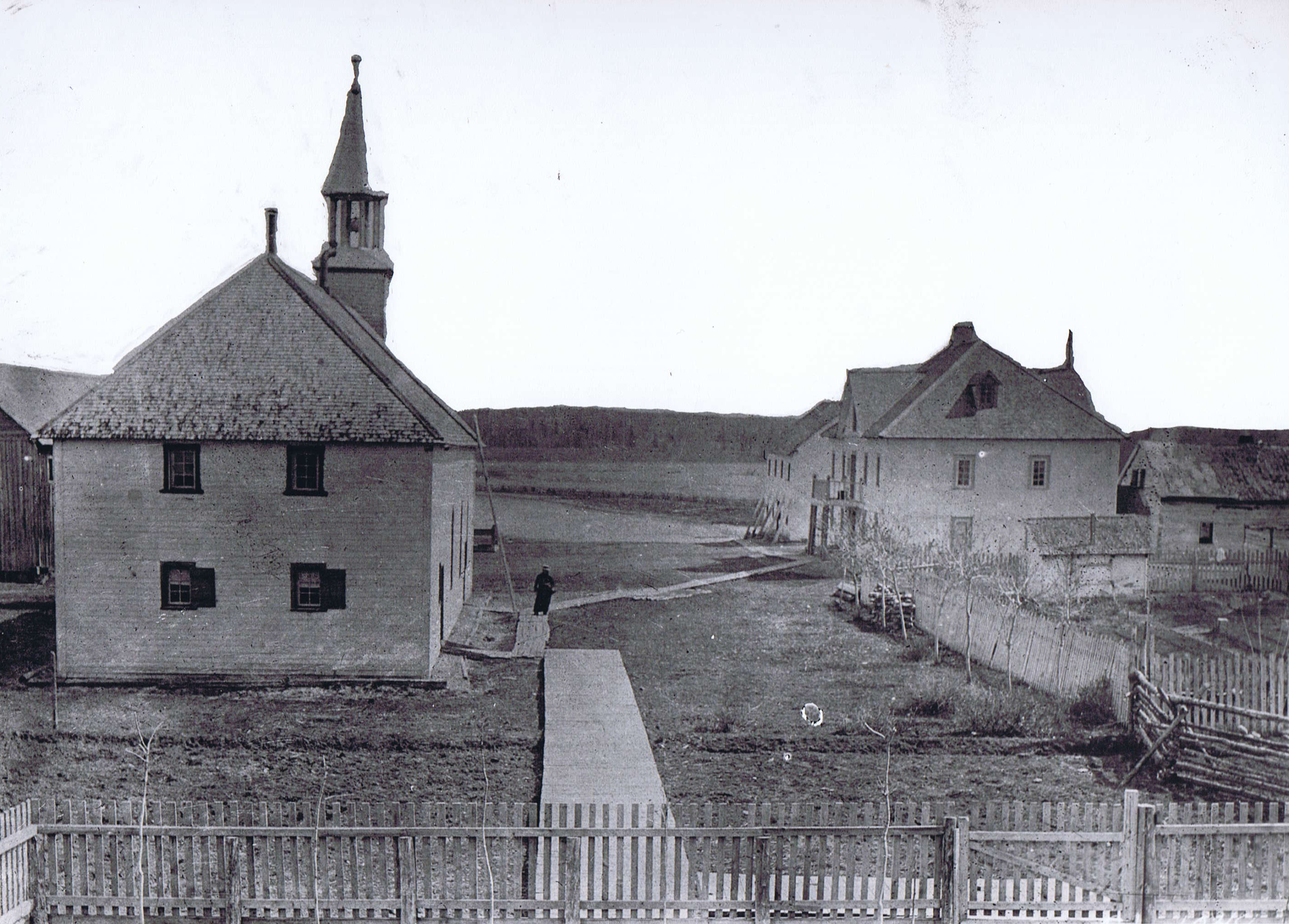
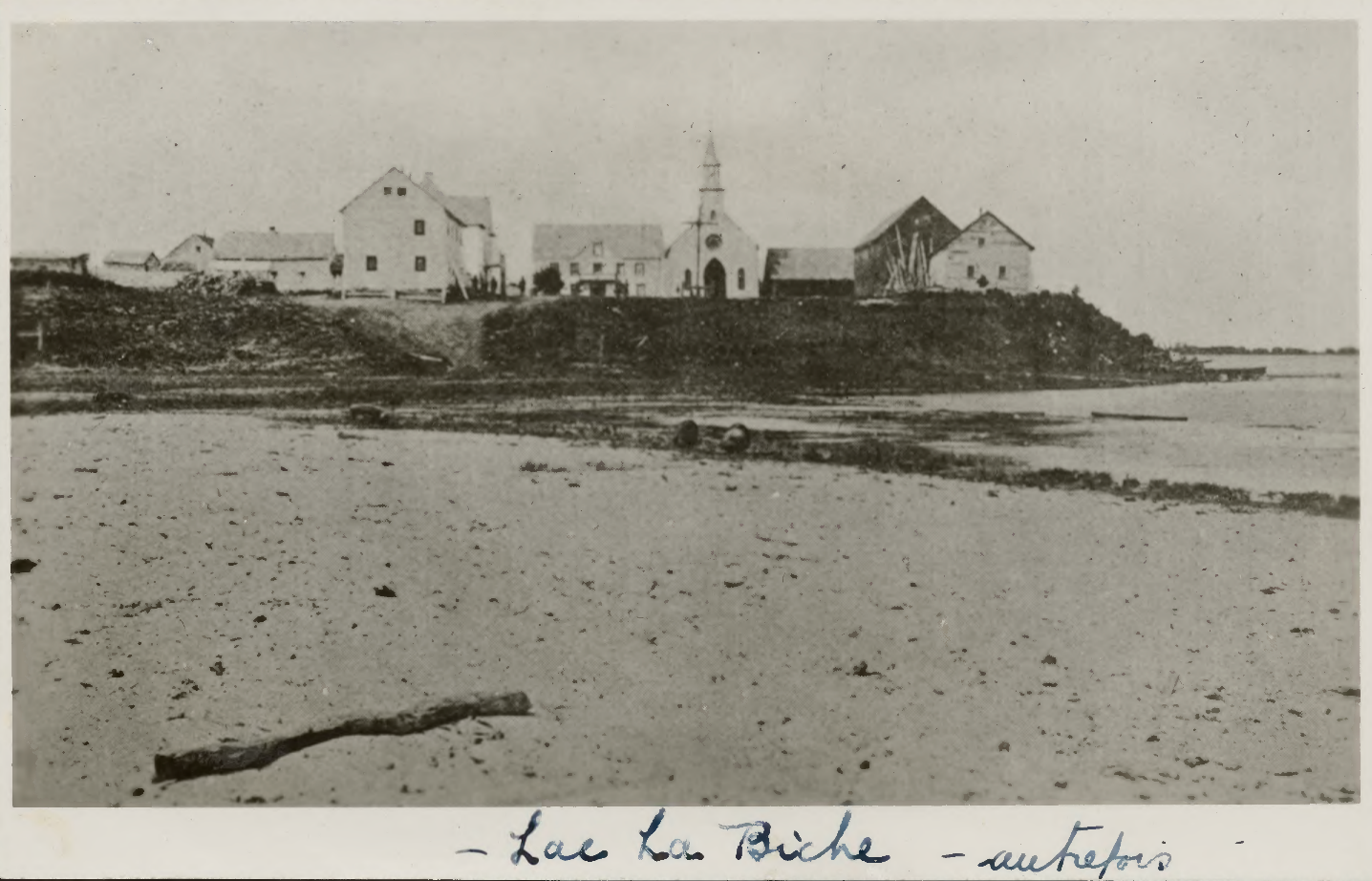
Notre Dame des Victoires, n.d. The Grey Nuns’ convent, where schooling took place, can be seen on the right side. The former residence of Bishop Henri Faraud can be seen behind it. Image courtesy of the Lac La Biche Mission Historical Society.
The Sisters taught between fifteen and twenty classes each week. Classes included English, French, Nêhiyawêwin (Cree), Dene (Chipewyan), theology, drawing, painting, and mathematics. The school at Lac La Biche held not only boarding students, but day students as well. Attendance records are rare, but a few numbers can still be found. For example, in 1876, there were twenty-five to thirty children attending school, and in 1886, there were thirty-eight.
“We currently have fourteen poor little girls and one orphan, as well as five boarders and some day pupils from time to time. All winter we took in little girls in order to prepare them for their First Communion; we were forced to put them up in the kitchen, and it goes without saying that it put the poor cooks in an awkward position. If we only had space in which to accommodate these poor little backwoods children, we would have the means to transform them into fervent Christians. […] Truly, these, poor backwoods children lack neither in talent, nor in spirit, nor in heart, but rather they are just lacking in culture. Oh, if only we had the resources, what good we could do!”
—Sister Youville, letter to Sister Charlebois, Assistant General of the Grey Nuns, April 12, 1875
Life in the area was often difficult due to the environment. Many people already living in the area, mainly Nêhiyawak (Cree), Métis, and (to a lesser extent) Dene, already knew how to thrive in the often harsh climate. However, most of the Oblates and nuns were from Montreal or France and were largely unused to having to provide entirely for themselves. There were three sources of food at the mission: hunting, farming, and fishing. It was rare for all three to fail at the same time, but there were instances when they would have to rely heavily on one source alone, usually fishing. In these instances, it would have been difficult to provide for the clergy, let alone large numbers of children.
“A quick word about our harvest: 150 bushels of barley and 138 bales of bad hay are all we have. Since last autumn, we have already eaten almost 80 bales. We estimate that we will sow 80 bales this spring, and beyond that we will just have to eat biscuits, etc. etc. from now until the next crop. Our potatoes kept well this winter; our garden crop was very small, and this year we will gather even less as we have so few seeds to plant. […] Our chickens are still alive, but only because of our care to winter them and to keep them away from the dogs. […] For two days now, the weather has been good; if this continues, we will soon be welcoming spring, which we anxiously await. Hay is rare and our animals are thin. I worry that many will die. Just today, April 12th, we’ve heard that the dike at the mill is broken, which means a lack of bread. The travelers take with them the little bit of flour that we have left. At the house, we live as well as we can. At least we have lots of fish to eat.”
—Sister Youville, letter to Sister Charlebois, Assistant General of the Grey Nuns, April 12, 1875
Living in a religious environment would have been no easy task as well. Many members of the clergy at the Lac La Biche Mission, including Bishop Henri Faraud, were noted to be very strict with the sacraments (Baptism, Confirmation or Chrismation, Eucharist, Penance, Anointing of the Sick, Holy Orders, and Matrimony) to the point that they were accused of being “tainted with Jansenism” by Bishop Grandin in the late 1860s. Jansenism, characterized by severe self-discipline, was condemned by the Roman Catholic Church in the 1600s. According to Bishop Grandin, the Oblates at Lac La Biche were being overly strict with the Métis and First Nations dealing with Christianity for the first time. Bishop Grandin also remarked that they should not have been held to the same standards as Europeans raised in Christianity.
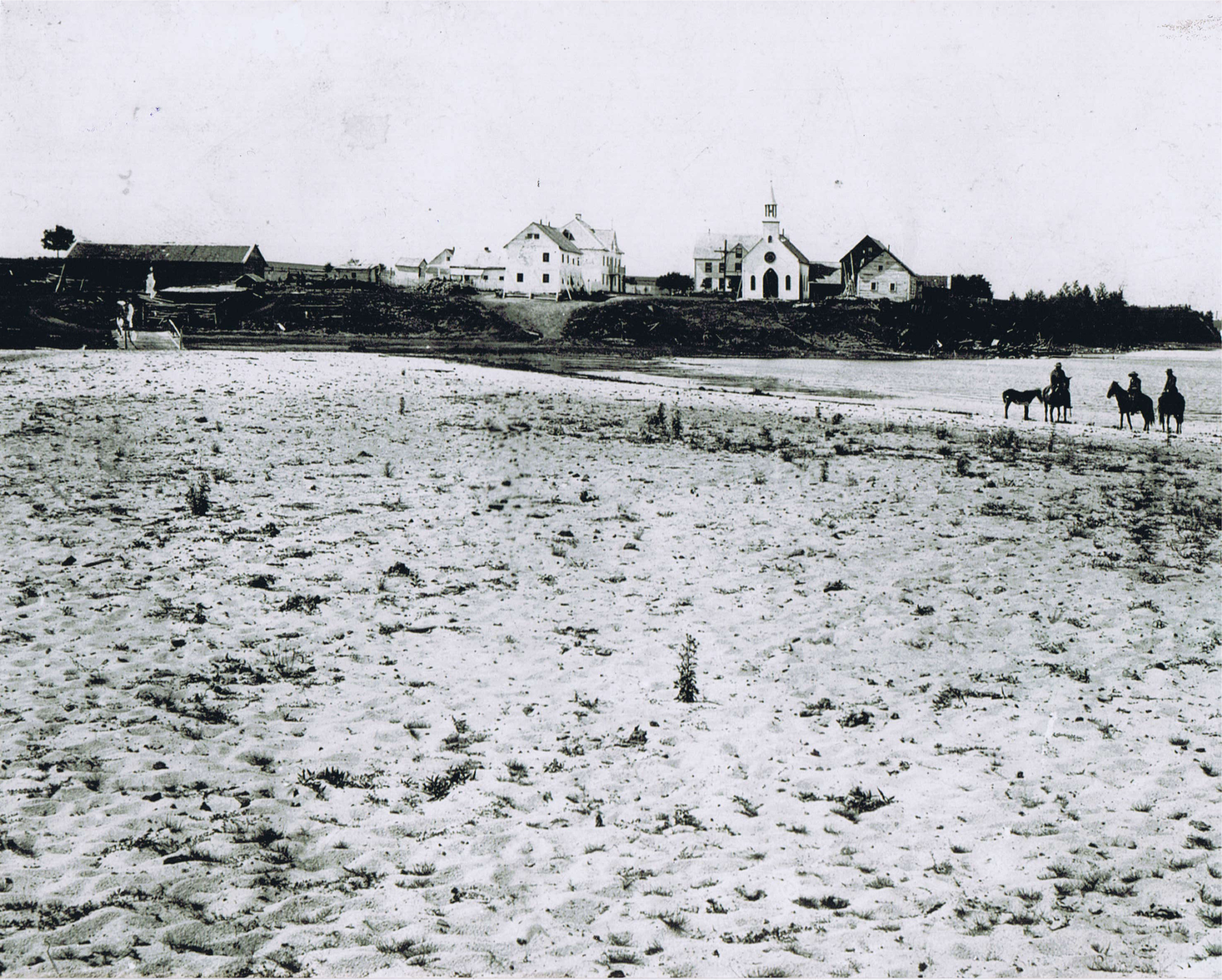
Lac La Biche Mission Beach. Image courtesy of the Lac La Biche Mission Historical Society.
Hospice St. Joseph was initially open from 1862-1872, when it closed due to poor enrollment. It did reopen when more students were available by 1875. Once steamboats were travelling on the Athabasca River in 1887, Notre Dame des Victoires began to be bypassed as a stopping point and warehouse for trade in the north. Many Métis from the mission area relocated to Athabasca Landing for work. With the loss of a portion of its congregation and the students with it, the mission attempted to make up for its loss in part through funding from the Dominion Government for industrial schools. Eventually, the school received funding to become an residential school, which officially opened in 1893.
Lac La Biche Residential School 1893-1898
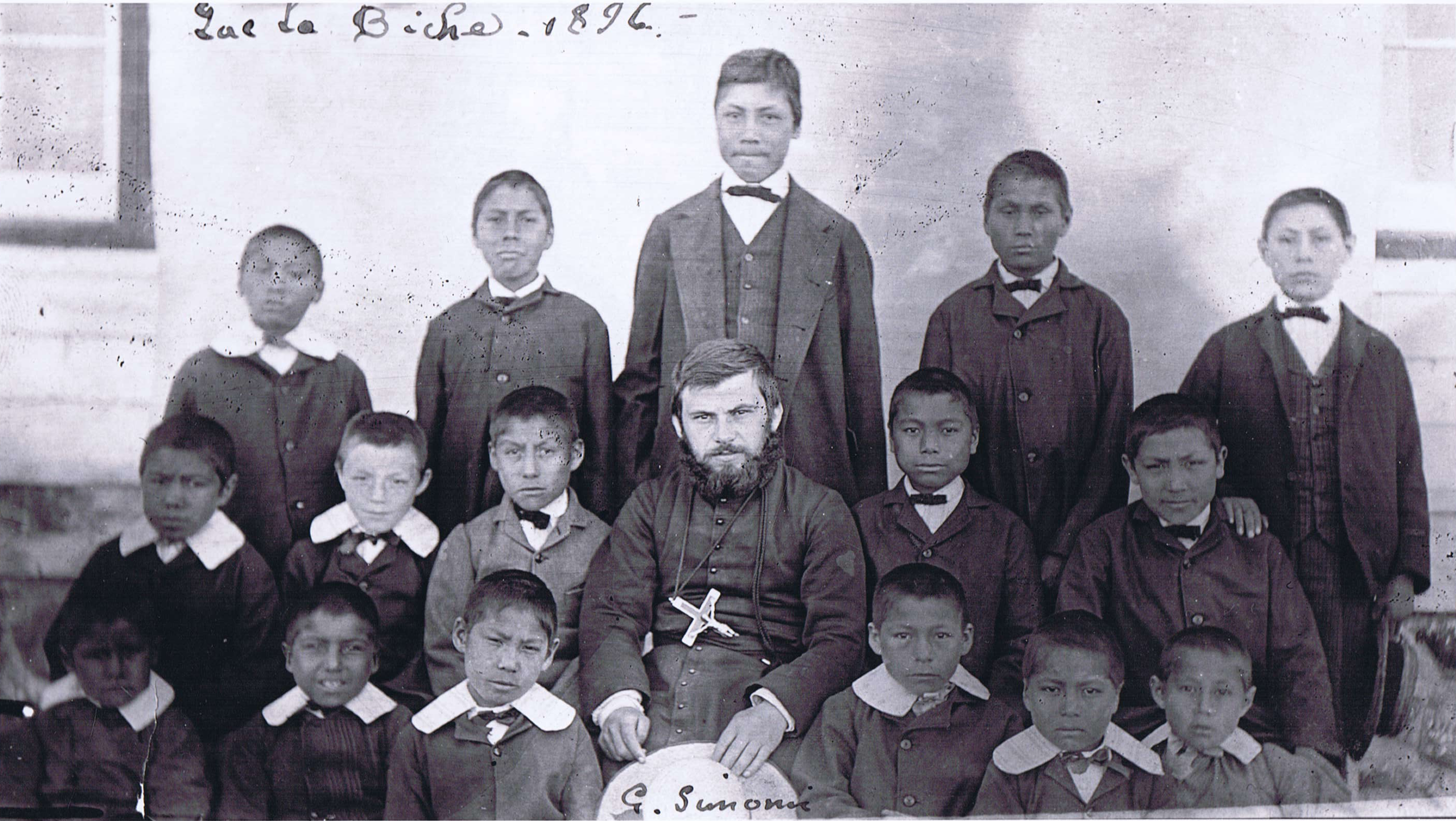
1896 Class pictured with one of the Oblate priests. Provincial Archives of Alberta, OB4486.
Notre Dame des Victoires was an industrial school. This means that in addition to academic classes, students were taught skills that could be used in different industries. Father Henri Grandin, who became superior of the Lac La Biche Mission in 1889, sent a latter to the Superior General of Indian Affairs on June 30, 1897, mentioning that the industrial classes included farming, gardening, sewing, knitting, cooking, laundry, and housekeeping. Roman Catholic mission classes also often included carpentry and boat building.
“Would it be too much to ask the Department to instruct their Agent to use his influence with his Indians in order to bring the parents to leave their children at school until we are satisfied that they know enough to be benefited by their stay with us. This is our greatest difficulty just now. After three or four years, and even some times after only two years in the School, parents must take their children away, to have their help in their work. Good advice from the Agent or [farm] instructor at such time would induce some of the parents, if not all, to leave their children with us and it would be a great help to us.”
—Bishop Vital-Justin Grandin, letter to Indian Commissioner Amédée E. Forget, April 14, 1897
With the reports from the Truth and Reconciliation Commission, many reports of sexual abuse have been brought to light. In regard to Lac La Biche, however, there are no documented instances of this abuse during the years that Notre Dame des Victoires was a residential school. The only mention found pertaining to Lac La Biche at all by the Truth and Reconciliation Commission was a letter from Father Jean Tissot at Lac La Biche to Bishop Alexandre-Antonin Tachédated April 19, 1861. He mentioned that he was not surprised that Jean L’Heureux was sent away from Fort Pitt in the 1860s for making sexual overtures to young boys, as Tissot had heard of his unsavoury reputation. Note: The TRC’s report erroneously states that L’Heureux was sent away from Lac La Biche, but the actual letter says Fort Pitt. L’Heureux’s career over the next thirty years included impersonating a Jesuit priest, impersonating an Oblate priest, serving as a translator during the negotiation of Treaty 7, and working as a translator for Indian Affairs. He resigned from this last position in 1891 when it was again discovered that he was sexually abusing young boys. From the records, it does not appear that a criminal investigation was ever opened, as was the case with many similar incidents. In the vast majority of cases, government and church officials were more likely to simply fire the abuser or encourage their resignation than bring criminal charges.
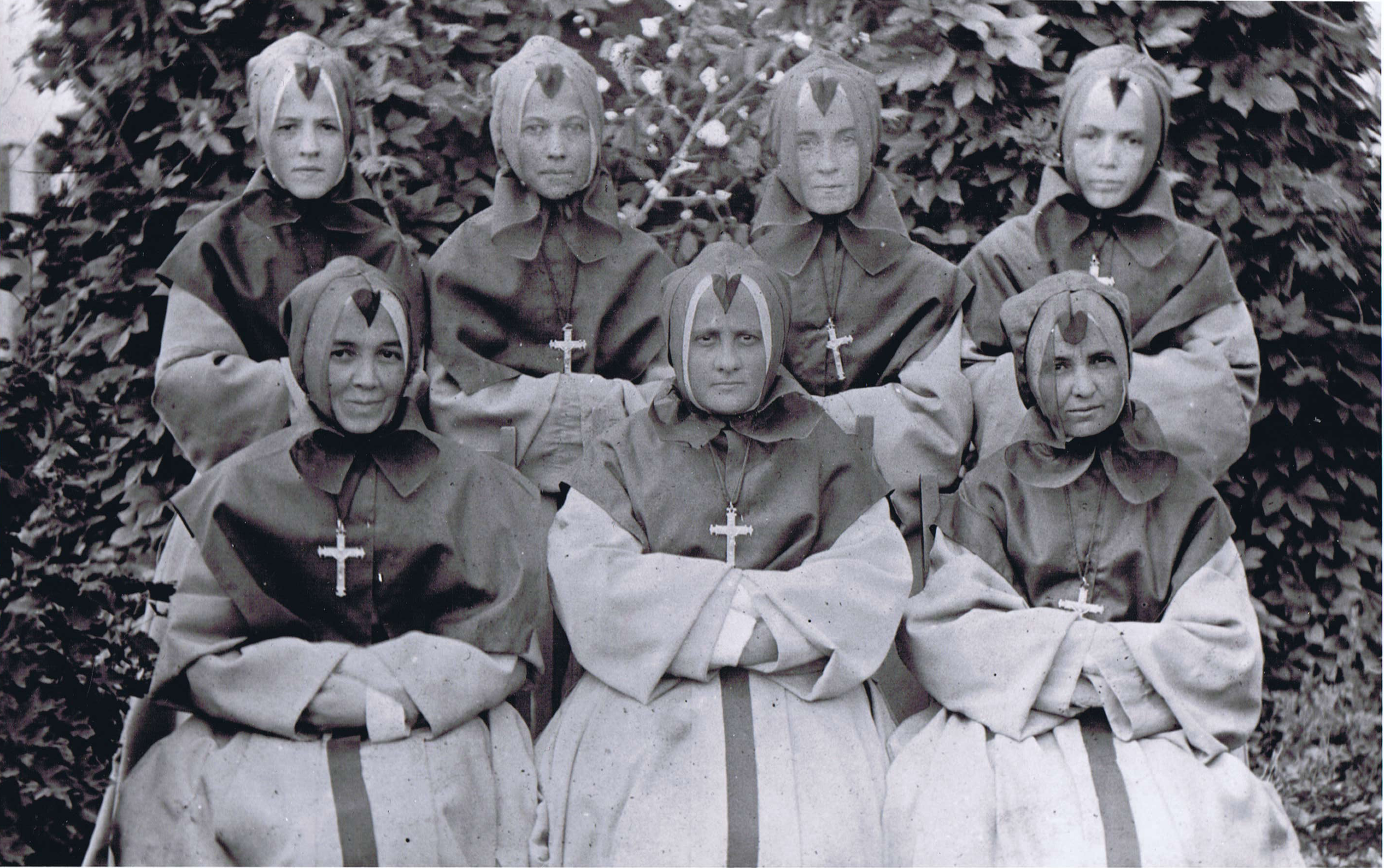
The Grey Nuns from the LLB Mission in 1895. Back Row, L-R: Sr. Cecilia Dougherty (age 31, in LLB 1891-1901), Sr. Béliveau [Louise Arsenault] (age 47, in LLB 1888-1898), Sr. Louise Pomminville (age 30, in LLB 1887-1898), Sr. Olivine Briault (age 24, in LLB 1891-1898). Front Row, L-R: Sr. St. Amable [Odolmire Mercier] (age 33, in LLB 1881-1898), Sr. Marie Niquette [Superior] (age 38, in LLB 1881-1888. 1891-1898), Sr. St. Augustin [Ada Leduc] (age 30, in LLB 1887-1900). Provincial Archives of Alberta, OB1023.
In 1896, it was discovered by government officials that the convent used as the Lac La Biche school was dilapidated. By this point, the nuns, orphans, and students were living in the former residence of Bishop Henri Faraud and taking classes in the old Grey Nuns’ convent. To the officials, this was convenient timing; parents at Saddle Lake wanted a residential school closer to home. The Saddle Lake parents wanted schooling for their children, but were trying to prevent their children from attending the residential school in Lac La Biche due in part to the rough roads and difficult visitation. The nuns were notified that the school was to be moved to Saddle Lake and the bishops agreed with the decision. In 1898, the school was officially moved to Saddle Lake. In 1931, the school was moved again to St. Paul. After a successful protest movement, the school was put under First Nations administration. It is currently the University nuhelot’įne thaiyots’į nistameyimâkanak Blue Quills.
Lac La Biche Boarding School 1905-1963
The boarding school at the Lac La Biche Mission did not open again until 1905 with the arrival of the Daughters of Jesus (French: Filles de Jésus). This school was open to all who wished to attend regardless of ethnicity, although the students were presumably Roman Catholic. This school, as mentioned earlier, was not a residential school. Many former students still live in the region.
“It was a really good convent as far as they go. […] The school was known for teaching French. It was pretty good; I wish some of my kids would have been taught there.”
—Edgar Ladouceur, 1981 Pow Wow Supplement
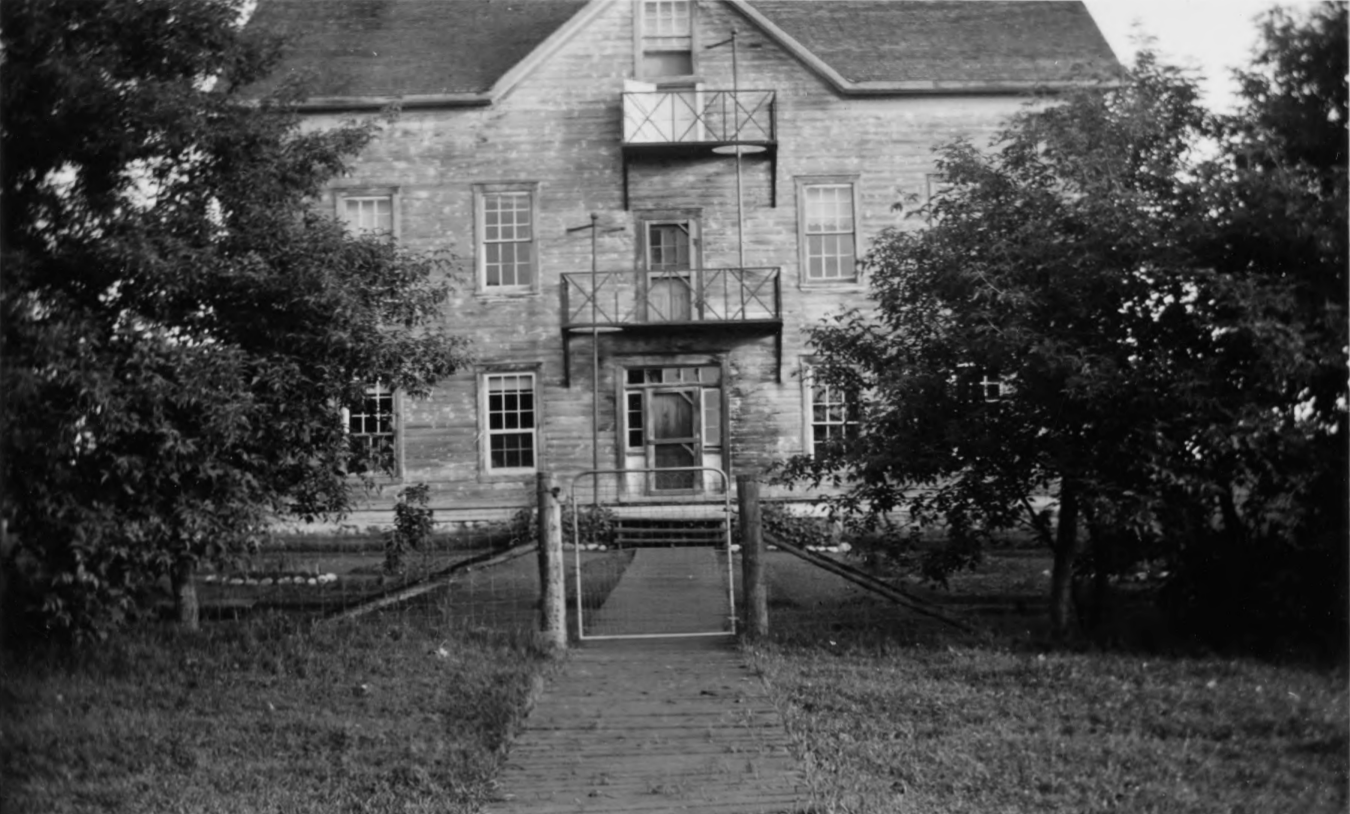
Convent of the Daughters of Jesus. Deschatelets Archive, Les Oeuvres Oblates de l’Ontario.
Theresa Meltenberger, who attended the school for five years during the 1930s and 1940s, noted that she was placed in the school by her mother while her parents were out in the bush. According to Meltenberger, education was her mother’s main priority. Although she had difficulties with proper nutrition and discipline, she had this to say:
“It certainly has given me an understanding of life and I don’t want to judge this by today’s standards because the nuns most likely figured they were doing God’s work, you know. So who am I to assess blame to them, you know, but it took me a long time to come to terms with it. […] So the good Lord says you are supposed to forgive, but there’s nothing in there that says you forget.”
—Theresa Meltenberger, resident at Lac La Biche Boarding School
Throughout the rest of her interview, which can be found in Métis Memories of Residential Schools, published by the Métis Nation of Alberta, she also notes that she learned important skills and was proud that she and the other children had a great deal of fun during recreation time. Their play included swimming and building forts, rafts, and snowballs. Other students who attended the school around the same time stated that the nuns were strict, but no one was abused.
Reconciliation
It is up to us as people living together in this country to work together for reconciliation to happen. Without commitment, reconciliation is impossible to achieve. Those who do not know the past cannot realize how it effects each of us today.
In the Commission’s view, there is an urgent need in Canada to develop historically literate citizens who understand why and how the past is relevant to their own lives and the future of the country. Museums have an ethical responsibility to foster national reconciliation, and not simply tell one party’s version of the past.
—Honouring the Truth, Reconciling the Future: Summary of the Final Report of the Truth and Reconciliation Commission of Canada, page 251
It is quite difficult to research the years in which Notre Dame des Victoires was a residential school, as many records are split between the Provincial Archives of Alberta and the archives at the Centre du patrimoine in St. Boniface. We can already see a limited vision of the past through what small resources are available to us. However, we must listen to the testimony of witnesses and survivors of the residential school system in order to give meaning to the past. The experiences of students at residential schools were both positive and negative, with some children having an overall positive experience and many having an overwhelmingly horrifying experience. Their testimonies are all valid and the experience of one former student is not necessarily the same as another. It is our hope that former students can continue sharing their stories with us all and that we as residents of the Lac La Biche region can move together towards reconciliation with understanding.
Notre Dame des Victoires, 1905-1921. Deschatelets Archive, Les Oeuvres Oblates de l’Ontario.
We thank the Lac La Biche Mission Historical Society for their contributions to this article. To learn more about Notre Dame des Victoires, we recommend visiting the Lac La Biche Mission site. Directions can be found at their website.
Ukrainian culture is right at home in our community, from delicious cuisine to lively dance. Canadian Ukrainian culture is special—it follows old traditions long left behind by most modern Ukrainians, creating an oasis of folk customs.
Ukrainian advertisement for land in Canada
The first wave of Ukrainian settlement in our region occurred in the Venice and Craigend areas between 1929 and 1932. During the early 1900s, the Canadian government’s immigration policy favoured farming experience over country of origin. This brought thousands of Ukrainian farming families to western Canada. The majority of Ukrainians who arrived in Canada came from western Ukraine under many names—Ukrainians, Ruthenians, Galicians, and Bukovynians. These Ukrainians were among many new Canadian farmers who put many hours of hard labour into clearing land to make it suitable for farming.
Many families learned Ukrainian at home as their first language, reading and writing in Ukrainian before learning English in school. In the early 1980s, the Ukrainian Cultural Society of Lac La Biche offered Ukrainian language classes as well.
“My grandfather was army personnel in Ukraine and he kinda figured there would be another war coming up. They said they had to get out of there. So him and his wife packed up six kids and got on the ship and came to Edmonton in 1930. They wandered around to get a homestead out here in Lac la Biche. They went to Wandering River; they [had previously] went to Peace River country and it was too far away from the markets and all that. Wandering River was still too far. They liked the train. There was a creek there and they settled right down in 1935. It took them 5 years to get a place for themselves. They were just like nomads walking around. Y’know, the challenges they had in those days… they were in a strange country, they didn’t know the English language. They came with a trunk of clothes packed with six kids.”
—Eugene Uganecz
Members of both the Ukrainian Orthodox and Ukrainian Catholic religions often follow the Julian calendar for their religious holidays. The Ukrainian Greek Catholic Church is a Byzantine Rite Eastern Catholic Church, while Roman Catholics belong to the Latin Church and follow the Gregorian calendar. The Julian calendar, named for Julius Caesar, is about two weeks out of alignment with our current calendar, the Gregorian calendar, which is named for Pope Gregory XIII. This means, for example, that Christmas is celebrated in January. While the Catholic church in Ukraine follows the Julian calendar, churches in Canada sometimes have permission to follow the Gregorian calendar instead.
In 1931, the community of Craigend began planning for the first Ukrainian Greek Orthodox Church in the region; however, services were eventually moved to Lac La Biche. In 1955, construction began on a new church, the All Saints Orthodox Church, which was built through volunteer labour and community effort.
Pysanky on loan from the Wowk Family
One of the most important Ukrainian holidays is Easter. Joyous exchanges of “Khrystos voskres!” (“Christ has risen,” Христос воскрес) and “Voistynu voskres!” (“He has risen, indeed,” воістину воскрес) can be heard in churches as families bring a basket of paska (паска, round Easter bread), babka (бабка, cylindrical Easter bread), boiled eggs, meat, cheese, and pysanky (писанки, dyed Easter eggs) to be blessed by the priest. Pysanky (singular: pysanka, писанка) are decorated using dyes and beeswax. Wax is placed on an egg by a kistka (кістка), a tool with a small funnel attached where melted wax is inserted. The wax protects the colour underneath from the dye in which the egg is placed. There are several symbols used on pysanky, including (but not limited to) geometric designs, Christian images, plants, animals, and man-made tools. Dye colours also have special meanings, such as blue for good health and yellow for the harvest. In regards to Easter, this year (2017) is quite special—Easter falls on the same day on both the Julian and Gregorian calendars.
“On Easter we bake bread: paska and babka. We put them in baskets and take them to church. Everybody brings their baskets and puts them in a semi-circle where a priest comes and blesses everything. What else do we do at Easter? We have a little sip of holy water. He blesses the holy water and he brings some home.”
—Loveth & John Beniuk
Malanka (Маланка), the New Year’s celebration, is named after Malanka, the daughter of Mother Earth, whose return marks the beginning of spring. During Malanka, one can eat many delicious treats, such as kutia (кутя), a dish of poppy seeds, wheat, honey, and almonds, symbolizing peace, prosperity, and good health. Ukrainian staples such as varenyky (вареники, often called perogies or pyrohy by Canadian Ukrainians), grechka (гречка, buckwheat) pancakes, and kielbasa (колбаса, sausage, often called kubasa by Canadian Ukrainians).
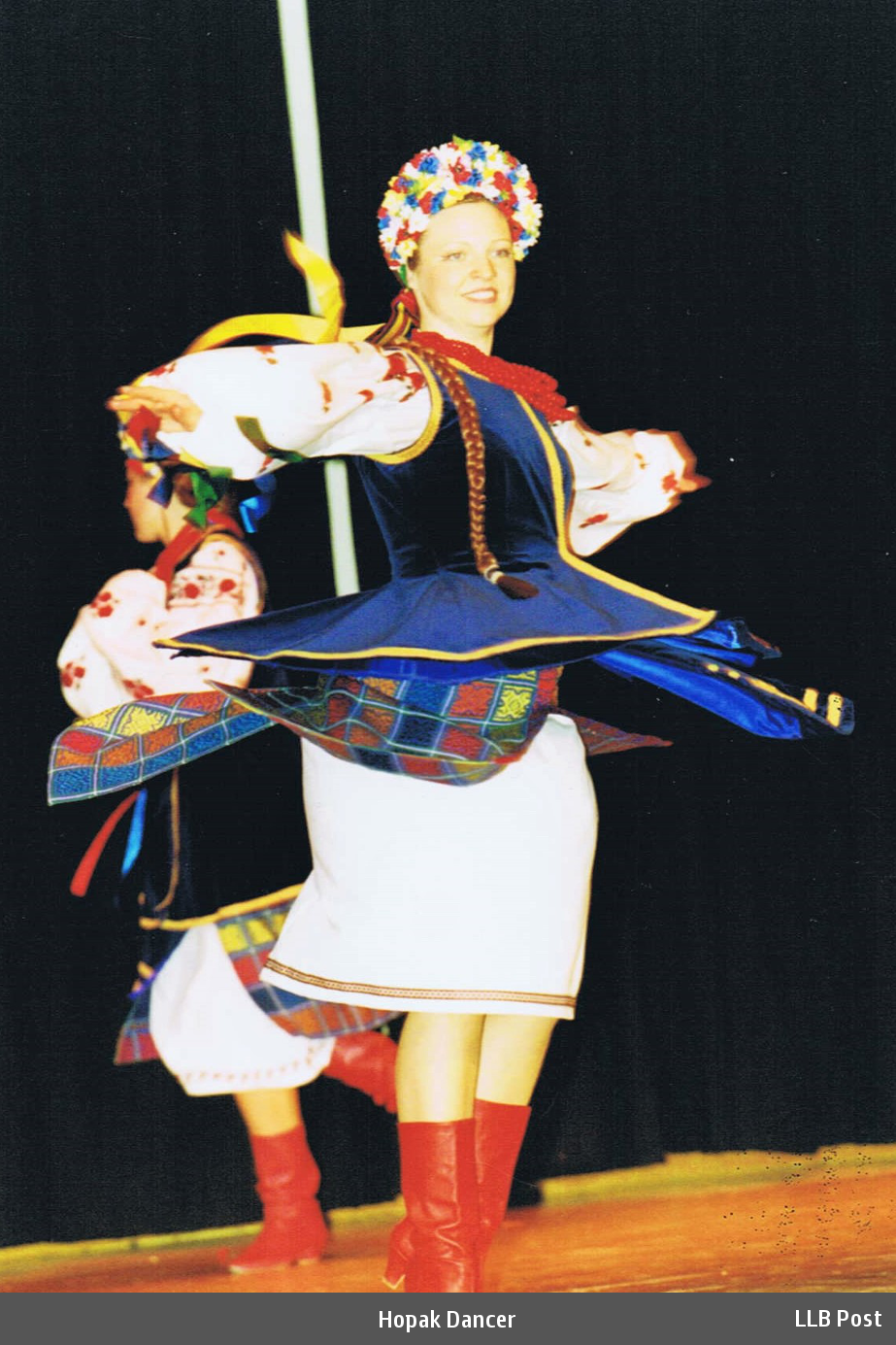
Ukrainian dance is characterized by rhythmic stamps, acrobatic jumps, and elegant twirls. The national dance, Hopak (гопак, from the verb гоп, “to jump”), is the most popular dance with impressive solos. Concerts often begin with the Pryvit (привіт, “welcome”), a welcome dance complete with the traditional offering of bread and salt. Various costumes are worn for the Pryvit, showcasing the regional dances performed during the concert. Most other styles of Ukrainian dance are named for the regions they come from, such as Polissia, Volhynia, and Bukovyna (Polissian, Volyn, and Bukovynian respectively). The Lac La Biche Cerna Dancers performed these traditional dances on stage for many years.
Ukrainian embroidery is easily recognized. Traditional embroidery patterns vary according to region of origin and are often characterized by kalyna (калина, guelder-roses), poppies, lozenges (diamonds), and geometric patterns. Red and black are standard colours used for embroidery, but are often accompanied by blue, yellow, and green. Embroidery is put on the regions where evil spirits could enter the body to protect the person wearing it—at the cuffs, neckline, back, shoulders, and hem.